Internal Architecture
How you process, interpret, and make meaning.
Human Potential Architecture
I call the way our inner life, habits, identity, and surroundings work together Human Potential Architecture. It is a practical way to notice what is shaping your choices beneath the behavior you can see.
Why change can be difficult
You may understand the pattern, make a decision, and take action. Then a stressful week arrives and the old response is back. That is not a character flaw. It usually means there is more to understand than the visible behavior.
The model
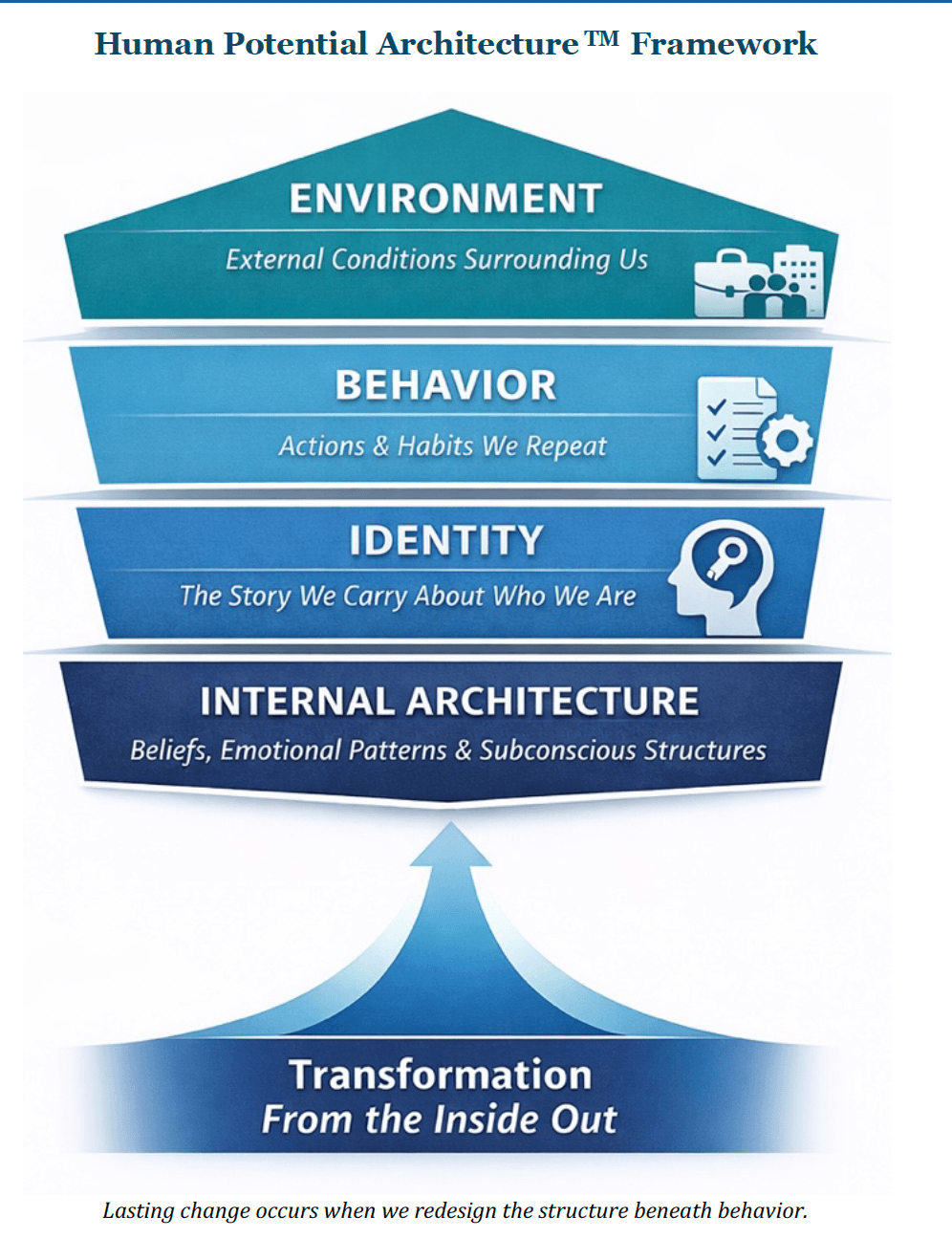
How you process, interpret, and make meaning.
How you see yourself and what you believe is possible.
The actions you take and habits you form.
The systems and relationships that reinforce patterns.
The four layers in ordinary life
These layers are connected, but they are not interchangeable. I use them to slow down the story and notice what is actually shaping a choice.
This is the way you process experience and make meaning from it. It includes the attention you give something, the meaning you attach to it, and the expectations your mind brings forward. For example, a short email from your manager may register as a warning before you have any evidence that something is wrong. When this layer shifts, you can notice the interpretation as it happens and make room for another reading.
Identity is the story you hold about who you are and what is possible for someone like you. A new manager may believe that being valuable means having the answer before anyone else has spoken, so asking for help feels like exposure. When that story shifts, a request for support can become a responsible part of leading rather than proof that you do not belong.
Behavior is what can be seen in the choices and habits that follow. You may keep revising a proposal instead of sending it, or agree to another task when your week is already full. When this layer shifts, a different action becomes available. You can send the draft, name the limit, or have the conversation before the pressure makes the decision for you.
Environment is the surrounding system of people, routines, expectations, and consequences. A team may say it wants thoughtful work while rewarding the person who answers every message immediately. When this layer shifts, the people and systems around you can support the change. That may mean changing a meeting, making a responsibility visible, or asking for a different agreement.
Why the order matters
Imagine a leader who wants to stop answering every email at night. They buy a time management book, block the calendar, and tell the team that responses can wait until morning. For a week, the new behavior holds. Then a difficult project lands, the old worry returns, and the late-night replies begin again.
Starting with the visible behavior was not useless. It simply did not answer the question underneath it. The leader may believe that being available is what makes them dependable, while their mind treats a delayed response as a sign of danger. When we understand those layers and adjust the agreement the team is working inside, the new habit has something stronger to support it.
Why this matters
The shift
Behavior matters, but it is usually the last part of the story. I want to understand what is supporting it and what it is protecting.
What we can observe
Environment
Behavior
Identity
Where I usually begin
Internal Architecture
Identity
Behavior
Environment
When the foundation changes, everything built on it shifts.
Go deeper with the framework
The full Human Potential Architecture guide brings the four layers together with more room to think about how they affect one another.
Download the Framework GuideFree download, 10 minute read
How this shows up in my work
I use the framework as a way to choose the right place to begin, not as a test you have to pass. With assessments, we do awareness work that gives us a clearer picture of how you operate. In coaching conversations, we apply that understanding to a live decision or challenge. With hypnosis, we work with patterns that sit below conscious reasoning and have not shifted through insight alone.
A few practical questions
It is a way of thinking that helps me ask better questions. It gives the work a useful order, but it is not a rigid process with the same answer for everyone.
No. You do not need to name the layer before we begin. I use the model in the background and explain the parts that help make your situation clearer.
DISC and the other assessments can give us useful information about patterns in communication, motivation, and behavior. Human Potential Architecture helps us ask what may be underneath those patterns and what in the surrounding environment keeps them in place. The assessment is a starting point, not the whole explanation.
In Their Words
“This work made it clear what was driving my decisions and behavior. That clarity allowed me to move forward with greater focus and alignment.”
Anna Park
Education Professional
A next step